
What you’ll discover
Toll roads, parking garages, patrol cars and roadside poles can all use the same kind of machine: a camera and software that turn a picture of a license plate into characters, and the characters into a record. This episode follows that process step by step.
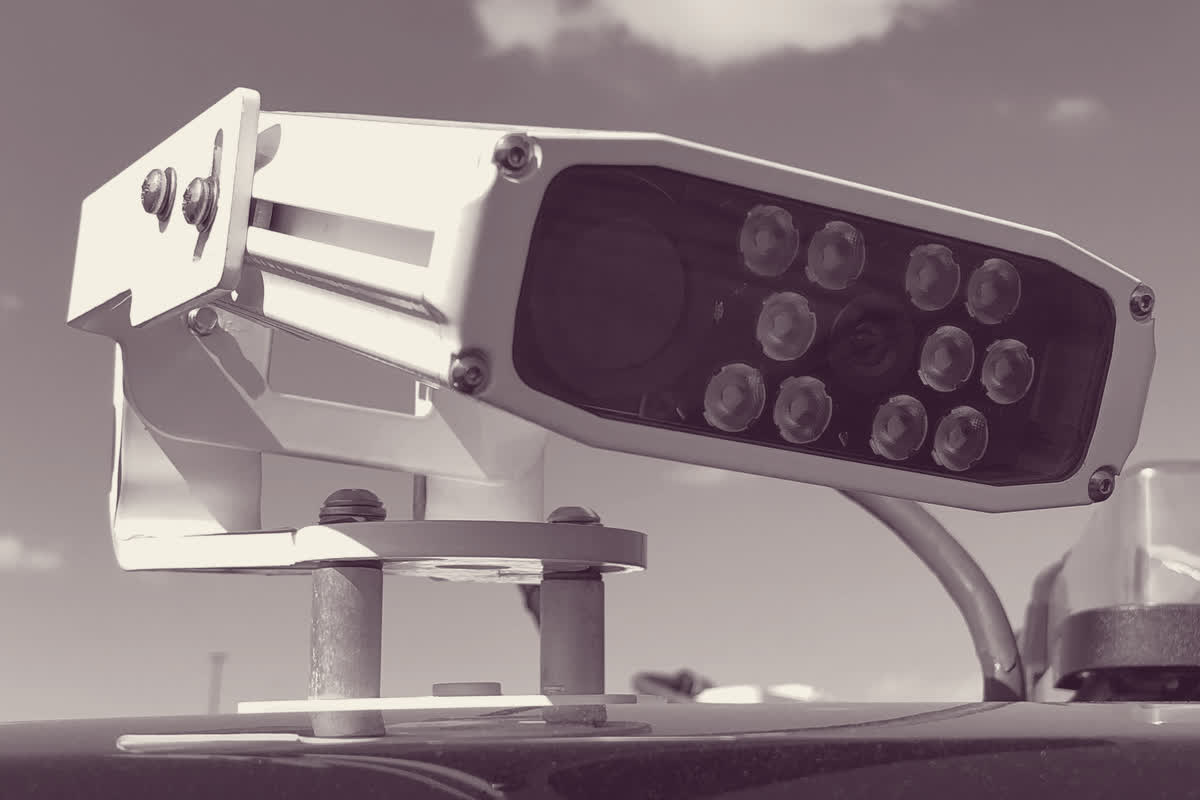

It explains why exposure time, infrared light and reflective plate material decide whether a plate can be read at night, how software finds the plate in an image, straightens it and reads each character, and why a confident reading can still be wrong. It then shows how each read, the characters with a time and a place, can be checked against a list of vehicles of interest or stored and searched later, and what sightings of the same plate at different cameras can and cannot reveal.
A license plate reader can record where and when a plate was observed. That is not the same as identifying the person driving.
Listen and watch
Plays from YouTube. Nothing is loaded from YouTube until you press play.
Artwork photograph: “ANPR Camera Front” by Mbrickn, Wikimedia Commons, CC BY 4.0; cropped, duotone (licence).
Remastered edition on the way
The remaster is finished and awaiting release. The original edition stays public until the remaster is released. It has no release date yet.
Sections: original edition
- 1The plate that glows
- 2One machine, many jobs
- 3The photograph problem
- 4Bringing its own light
- 5Finding and straightening the plate
- 6Reading the characters
- 7How sure is it?
- 8The read
- 9Finding one plate among millions of reads
- 10The list it’s watching for
- 11When reads become journeys
- 12What the machine can’t be sure of
- 13What the read establishes
About these chapters
Section titles from the script the edition was narrated from. Start times have not been measured for this edition yet, and the YouTube description has no chapters.
Transcript
A transcript will be published with the remastered edition. Machine-made captions are not published here as transcripts.
Research sources
Each source is listed with the ID it has in the episode’s research ledger. Open a group to see the list.
How this list was made
Every source below is a row in the episode’s research source ledger (the technical update of October 2026), shown with the ledger’s own ID, title and type label. Manufacturer documents are listed because they describe how the equipment is built; a listing is not an endorsement. Where the ledger records only a shortened locator, no link is given. Links were recorded during research and have not been re-checked for this page.
Type labels are the research ledger’s own. Source-type key: STD standard/specification · GOV government or institutional · PEER peer-reviewed · TECH vendor technical documentation · PAT patent · SEC secondary.
Research evidence the episode rests on 24 sources
Show the listHide the list
Sources cited for the script’s claims in the fact-check of its first full draft (3 Oct 2026).
- S1AAMVA Law Enforcement Committee, License Plate Reader Program Best Practices Guide, Edition 2, August 2025 (51 pp.)GOV / institutional (industry association of motor-vehicle administrators)
- S2Raytec, "Application focus: Lighting for ANPR / LPR", 24 May 2022TECH (illuminator manufacturer)
- S33M, Reflective License Plate Sheeting 3750/3750P, Product Bulletin, March 2020Locator in the research record: multimedia.3m.com/mws/media/1216215O/…TECH (sheeting manufacturer)
- S53M patent application US 2015/0353029 A1, "High contrast retroreflective sheeting and license plates" (priority 2009)PAT
- S6Axton Technologies, Pulsar series LPR illuminators pageTECH
- S8Bosch Security Systems, Automatic license plate recognition (application note / white paper), 2020, 36 pp.TECH (camera manufacturer)
- S9Genetec, AutoVu SharpV product specifications, updated 26 Nov 2021TECH
- S10Laroca, R. et al., "A Robust Real-Time Automatic License Plate Recognition Based on the YOLO Detector", IJCNN 2018 (arXiv:1802.09567v6)PEER
- S11Silva, S. M. & Jung, C. R., "License Plate Detection and Recognition in Unconstrained Scenarios", ECCV 2018PEER
- S12Li, H. & Shen, C., "Reading Car License Plates Using Deep Convolutional Neural Networks and LSTMs", arXiv:1601.05610 (2016)PEER (preprint)
- S13OpenALPR open-source library: README, config/openalpr.conf.defaults, runtime_data/postprocess/us.patterns and readme.txt (GitHub, last push Jan 2024)TECH (open-source reference implementation; commercial successor is Rekor)
- S15Genetec TechDoc Hub, Security Center Administrator Guide 5.14 topics: "ALPR matcher technique: OCR equivalence"; "… Number of character differences"; "Best practices for configuring ALPR matcher settings"; "Wildcard hotlists"; "About hotlists" (topics last updated 2018–2025)TECH
- S17California Civil Code §1798.90.5 (definitions)Locator in the research record: leginfo.legislature.ca.gov … sectionNum=1798.90.5GOV (statute)
- S18UK Home Office, National ANPR Service Technical Specifications, Version 3.7, April 2026 (file named v3.6)GOV (national technical standard)
- S19UK Home Office, National ANPR Standards for Policing and Law Enforcement (NASPLE), Version 3.5, July 2026 (file named v3.4)GOV (national standard)
- S20U.S. DHS Science & Technology / NUSTL (SAVER programme), Automated License Plate Readers Market Survey Report, SAVER-T-MSR-57, June 2025GOV (federal technology survey; product data vendor-supplied and not independently verified, per the report)
- S21Congressional Research Service, Law Enforcement and Technology: Use of Automated License Plate Readers, R48160, 19 Aug 2024GOV
- S22Honolulu Police Department, policy "Automated License Plate Reader" (web page; no date or number shown)GOV (agency policy)
- S23Turner, S. M. et al. (Texas Transportation Institute), Travel Time Data Collection Handbook, FHWA-PL-98-035, March 1998, ch. 4GOV
- S24Office of the New York State Comptroller, New York State Thruway Authority: Selected Aspects of Toll Collections, Report 2022-S-15, May 2023GOV (state audit)
- S2518 U.S.C. §2721 (Driver's Privacy Protection Act)GOV (statute)
- S26Neal v. Fairfax County Police Department, Supreme Court of Virginia, Record Nos. 191127 & 191129, 22 Oct 2020 (opinion by McCullough, J.)GOV (appellate opinion; findings of fact about one department's system)
- S27Ushio America, "Ushio Epitex NIR LEDs for Automatic Number Plate Recognition (ANPR)" (web page, undated)TECH (LED manufacturer)
- S29US patent 9,641,806 B2, "Average speed detection with flash illumination", filed 12 Mar 2013, granted 2 May 2017 (3M; now Neology)PAT
Background reading 5 sources
Show the listHide the list
Opened during the technical research and recorded in the ledger, but not cited for a claim in that fact-check.
- S43M, High Definition Reflective License Plate Sheeting Series 6750, Product Bulletin, Oct 2022TECH
- S7Katz-Lacabe, M., "Dissection of Flock Safety camera", CEHRP, 30 Apr 2022 (already in v1 ledger)SEC (independent physical teardown)
- S14Genetec, Genetec Patroller Law Enforcement User Guide 6.7 (dated 2025-01-10), hosted by City of Alton, ILTECH
- S16Genetec TechDoc Hub, Genetec Patroller Administrator Guide 7.0, "Configuring hotlist settings"TECH
- S28GB patent application GB2448780A, "Method and apparatus for identifying a cloned number plate", Ranger Services Ltd, filed 26 Jul 2007, published 29 Oct 2008, withdrawnPAT
Reasoning and open questions
Some of what an episode says is the episode’s own reasoning from its sources, and some questions are still open. Each item carries the evidence label its research record gives it; labels are never raised on this page. What the labels mean is explained on the About page.
These items are from the original edition: its narrated script and its research ledger of October 2026.
Interpretation and analysis offered by the episode
Show the itemsHide the items
- Inference
A high confidence score does not guarantee a correct reading. The score says how strongly the image supports the characters the software chose; a crisp image of an ambiguous character can still score high and be wrong.
Sources: S20 - Inference
Setting the confidence cutoff trades one kind of error for another: set it high and correct readings get flagged or go unread; set it low and more wrong readings get through.
- Inference
A plate reading does not itself name anyone. Finding the registered owner is a separate lookup in motor-vehicle records, and the owner is not necessarily the driver.
Sources: S20
Unresolved questions and live debates
Show the itemsHide the items
- Disputed
Whether plate readers keep a picture of every vehicle. Sources disagree: a U.S. Department of Homeland Security survey says systems typically do not store all photos, while Britain’s standard requires a plate image for police reads and one examined U.S. county kept images for 364 days. The episode says only that what is saved varies between systems.
Sources: S20, S18, S26
Corrections and updates
Corrections
- No corrections.
Update history
Show the updatesHide the updates
- The remaster is finished and awaiting release. Its own research sources will be listed here when it is released; until then this page lists the original edition’s.
- Page created. Research sources listed from the original edition’s research ledger (its technical update of October 2026).
Corrections fix factual errors and stay visible. Updates record routine improvements. See the corrections policy.